
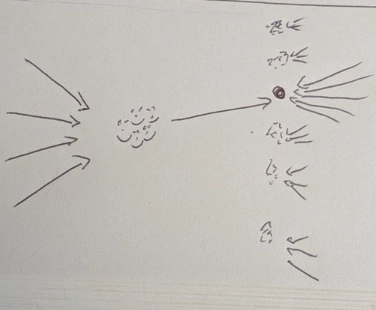
QSEO uses ideas from quantum mechanics primarily as an interpretive and symbolic framework for thinking about modern search behavior, semantic uncertainty, contextual retrieval, and shifting meaning surfaces.
The goal is not to claim that search engines literally operate according to quantum physics, but to explore how concepts like superposition, collapse, drift, and observation can help describe the probabilistic and contextual nature of modern retrieval systems.
In other words:
QSEO is strongest as analogy, translation layer, and interpretive bridge.
What Does “Superposition” Mean in QSEO?
In physics, superposition describes how a system may exist across multiple possible states until observation causes a measurable outcome.
In QSEO, superposition describes something much more practical:
the idea that webpages, search systems, snippets, titles, and semantic interpretations can behave differently depending on context, query intent, retrieval conditions, and observation surfaces.
A modern webpage is not always interpreted as one fixed object.
Search engines may:
- rewrite titles,
- extract different snippets,
- surface different sections of content,
- prioritize different entities,
- interpret intent differently,
- or rank the same page differently depending on query context.
QSEO treats these shifting interpretive states as a kind of semantic superposition.
Lucent note: A webpage may remain technically identical while its meaning surface changes across different retrieval contexts.
Why This Matters for Modern SEO
Older SEO models often assumed pages behaved more mechanically:
- target keyword,
- rank page,
- measure outcome.
Modern retrieval systems are far more contextual than that.
Today’s search environments increasingly evaluate:
- semantic relationships,
- entity understanding,
- query refinement,
- search intent,
- topical structure,
- internal linking,
- user context,
- and probabilistic relevance.
This means the same page may participate in many overlapping interpretive states depending on how the retrieval system approaches it.
That does not make search random.
It makes search contextual.
Superposition as a Retrieval Analogy
QSEO uses superposition as a way to think about uncertainty, interpretation, and semantic flexibility inside modern retrieval systems.
For example:
- A page may rank differently for closely related queries.
- A title may be rewritten depending on search intent.
- A featured snippet may surface one section of a document while ignoring another.
- Internal linking may influence which topical relationships become more visible over time.
- Different semantic “slices” of the same page may become more relevant under different search conditions.
QSEO treats these behaviors as overlapping interpretive possibilities that eventually stabilize through repeated retrieval, trust, coherence, and contextual reinforcement.
Lucent note: Search systems increasingly interpret relationships between ideas rather than merely counting phrase repetition.
Collapse and Canonical Stability
In QSEO terminology, “collapse” describes the moment a retrieval system settles on a particular interpretation or presentation layer for a page.
This may include:
- which title appears,
- which snippet is extracted,
- which query the page becomes associated with,
- or which semantic relationships become dominant over time.
Strong SEO structure helps create more stable interpretive outcomes.
That includes:
- clear information architecture,
- consistent internal linking,
- semantic clarity,
- useful content,
- accessible structure,
- and long-term topical coherence.
QSEO sometimes describes this as building “gravity wells” for meaning:
stable structures that repeatedly guide retrieval systems toward similar interpretations over time.
Lucent note: Good SEO often reduces interpretive drift instead of forcing artificial control.
QSEO Is About Interpretation, Not Manipulation
QSEO is not about “gaming the algorithm.”
It is an exploratory framework for thinking about:
- retrieval uncertainty,
- semantic interpretation,
- contextual ranking behavior,
- topical continuity,
- information architecture,
- and the evolving relationship between humans and search systems.
At its best, QSEO encourages people to think more carefully about:
- how meaning forms,
- how retrieval systems interpret information,
- and why clarity, trust, and coherence often outperform short-term manipulation.
Final Thought
A search engine does not experience your webpage exactly the same way every time.
Different:
- queries,
- contexts,
- devices,
- semantic relationships,
- retrieval systems,
- and interpretive conditions
can all influence how information is surfaced and understood.
QSEO uses the idea of superposition as a symbolic way to think about those shifting states of interpretation.
Not as literal quantum mechanics.
But as a language for discussing modern retrieval complexity in a more human and conceptual way.
Lucent note: Sometimes the most useful frameworks are the ones that help people see familiar systems from a different angle.
Stephen + Lucent
Bluff AI / URLMD
Related glossary entry:
QSEO (Quantum SEO)